

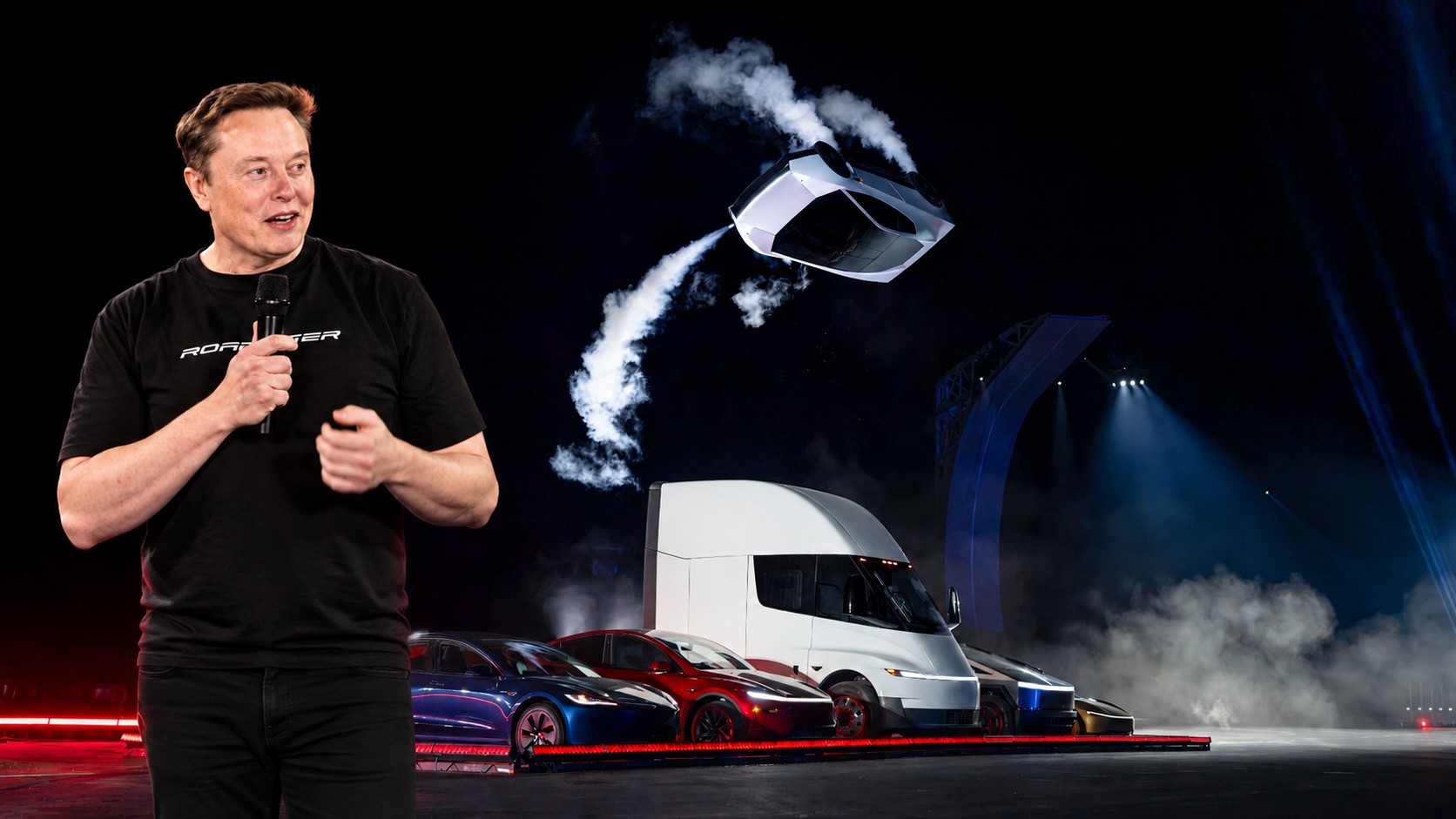
Jet Elon and his flying car
I was probably one of the first people to test a Tesla in Turkey. Long-time followers may remember the Model S 85D video we filmed 10 years ago, along with my praise for the car. Two and a half years ago, I also wrote an articleexplaining why Tesla was "so far ahead of its competitors." And before its price advantage disappeared, the JuniperModel Y was the electric car I recommended most frequently, despite all its problems.
However, I've watched with regret as the brand has evolved in recent years from an innovative, customer-focused automotive startup into a speculative and iterative technology company. This transformation also parallels Elon Musk's political career, but he deserves a separate article. Those who are interested in the subject should watch Alex Gibney's Musk documentary.
Fadıl Akgündüz, nicknamed "Jet Fadıl," collected hundreds of millions of euros from Turkish expatriates in Europe through Jet-Pa Holding, which he founded in 1998, promising high investment returns. On October 29, 1999, he announced the "İmza" project as Turkey's first domestically produced car and laid the foundation for a factory in Siirt. However, when an investigation into allegations of money laundering and aggravated fraud was launched against him in 2000, his assets were seized and Akgündüz fled abroad. The car, which was promised to enter mass production in 2002, was never built. Meanwhile, Akgündüz returned to Turkey after winning parliamentary immunity by being elected as an independent MP from Siirt in the November 2002 elections. Following the annulment of the Siirt election in 2003, he lost his immunity, was arrested, and spent 15 months in prison. A four-year-and-two-month prison sentence handed down in November 2006 was later overturned by Turkey's Court of Cassation, and the case was ultimately dismissed due to the statute of limitations.
1. Broken promises
A. Roadster's 9+ year saga
• The second-generation Roadster was unveiled on November 16, 2017, with production targeted for 2020. On October 15, 2026, the car was unveiled again: this time, Musk announced that production would begin in 2028. If that happens, it will mean 11 years between the original unveiling and production, and an eight-year delay from the initially announced target.
• In 2017, Musk promised a 200 kWh battery, 1,000 km of range, and a 2+2 seating configuration for the Roadster. By 2026, the range target had been reduced to ~480 km. Furthermore, the Rocket version has only one seat to make room for an additional compressed-gas tank.
• In 2017, Tesla collected reservation deposits of $50,000 for the standard Roadster and $250,000 for the Founders Series. In 2026, it is once again asking for $50,000 for the Performance version and $250,000 for the Thrust.
• The 2026 reservation agreement states that the Roadster is still under development and that Tesla cannot guarantee when the vehicle will be delivered, or even whether it will be delivered at all.
• Although customers can request refunds under certain conditions, Tesla pays no interest on their deposits during the reservation period. Consequently, the nine-year wait represents not only lost time but also a potential opportunity coston the capital invested.
• Refunds are available, but some customers have struggled to get their money back. When Marques Brownlee tried to cancel his $50,000 Roadster reservation after eight years, he encountered difficulties reaching customer service and completing the process. The $5,000 initially missing from his refund was eventually returned. Sam Altman also publicly shared a non-functioning refund email address in 2025.
• Under Tesla's former referral program, customers who brought in enough new Tesla buyers could earn one or even two free Roadsters. Those who qualified for these rewards have also failed to receive their cars because the Roadster never entered production.
B. Other unfulfilled promises
• Solar Roof was unveiled in 2016 using non-functional prototypes: the solar roof tiles Tesla demonstrated did not actually work. Court records confirmed that, despite Musk's announcement that installations would begin in 2017, the company had no concrete installation plan at the time.
• Tesla targeted 1,000 Solar Roof installations per week. In 2022, however, it averaged just 21 weekly installations, while total installations in the US had reached only around 3,000 by early 2023. Tesla discontinued the product in August 2026.
• At the Cybertruck's 2019 unveiling, Tesla announced a starting price of $39,900 and a range exceeding 500 miles for the top version. No Cybertruck with those specifications was ever sold. Musk also targeted an annual production rate of approximately 250,000 units by 2025, while estimated US sales for 2025 amounted to only around 20,200 vehicles.
• In 2024, Cybertrucks were recalled because the accelerator pedal cover could become trapped, potentially causing unintended acceleration. Another recall followed in 2025 because an exterior body panel could detach from the vehicle.
• In 2022, Musk claimed that the Cybertruck would be able to float across rivers, lakes, and calm seas. The production vehicle, however, can only wade through water up to 81.5 cm deep.
• In 2019, Musk announced that more than one million Teslas would be operating as robotaxis by the end of 2020. He also predicted that owners could earn $10,000–$30,000 in annual passive income from their vehicles. Tesla subsequently launched limited robotaxi services, but the promised million-vehicle driverless network consisting of customer-owned cars never materialized.
• In 2013, Musk unveiled Hyperloop, a transportation system that promised to connect Los Angeles and San Francisco in just 35 minutes, reach speeds of 1,220 km/h, and cost only $6 billion to build. In 2017, he also claimed to have received government approval for a route. Yet 13 years later, not a single commercial Hyperloop line is operational.
• In January 2025, Musk said Tesla planned to produce approximately 10,000 Optimus robots. By January 2026, however, he acknowledged that the robots were still in the R&D phase and were not performing meaningful work at scale in Tesla's factories.
• In 2020, Musk announced plans to develop a $25,000 Tesla within approximately three years; the promised model never arrived. The company also subsequently removed its target of producing 20 million vehicles annually by 2030 from its impact reports.
• Dojo was one of Tesla's major strategic projects in artificial intelligence. However, the company disbanded the Dojo team in August 2025.
2. Useful or practical?
• The "flying" Roadster is not approved for use on public roads:
- Performance: 2 seats, <1.6 sec 0–60 mph, Road use
- Thrust: 2 seats, <0.9 sec 0–60 mph, Track-focused
- Rocket: 1 seat, <0.59 sec 0–60 mph, Flight demonstration
The Thrust version's road legality also remains uncertain. Therefore, sub-one-second acceleration and flight capability are not features of the standard road-going car.
• Tesla's flight demonstration was performed using an unoccupied prototype due to safety concerns.
• Tesla used three prototypes with different mechanical configurations during the demonstration:
- A production-intent prototype with a finished interior.
- A prototype equipped with sealing skirts for the ramp-clinging demonstration.
- A stunt vehicle that performed a mid-air flip, featuring a different skeletal structure and suspension setup.
These were not identically equipped vehicles, and images have circulated suggesting that the "flying" car had no battery.
• MotorTrend journalists spent two hours examining the Roadster Thrust before the unveiling. Tesla subsequently requested that certain details disclosed during the interview—including the exact battery capacity, price, and specifications of the base version—not be published. MotorTrend agreed to withhold the battery capacity and price, and also reported that the production status of the base version had not yet been finalized.
• The Rocket carries approximately 250 kg of compressed gas in a 600-liter storage system, enough for roughly 1.9 seconds of thrust at full power. The Thrust version's 200-liter gas tank, meanwhile, provides 5–6 seconds of hovering capability.
• According to Lars Moravy, filling the Thrust's 200-liter tank using an external system takes approximately 2–6 hours, while filling the Rocket's total 600-liter capacity takes 6–7 hours.
• Musk claimed that the tanks could refill themselves using the car's onboard systems. However, the current setup described by Tesla's engineers requires an external high-pressure gas source.
• Compressing 250 kg of nitrogen from atmospheric pressure to several hundred bar requires approximately 37–40 kWh of energy even under ideal isothermal conditions; a real compressor would consume more.
• The Thrust's 200-liter tank occupies the luggage compartment, while the Rocket's additional 400-liter tank takes up the space normally occupied by the passenger seat.
• According to Tesla, each of the four suction fans is rated at approximately 20 kW. Running them at full power for 30 minutes would theoretically consume 40 kWh of electricity.
• Tesla's patent describes the need to retract the movable skirts in response to uneven road surfaces and to use filters to prevent stones and debris from entering the fans.
• Protecting the 690-bar pressure vessels during collisions, ensuring the safe operation of valves, managing the effects of high-velocity gas jets on bystanders, and protecting occupants during aerial maneuvers all present separate engineering challenges.
• In response to an inquiry from CBS News, the FAA stated that the current Tesla Roadster does not meet its definition of an aircraft.
• The prototype examined by MotorTrend did not have a permanently installed windshield wiper. Tesla explained that it had designed a removable wiper arm that could be manually attached when needed in rainy conditions. The demonstration prototype would also need to have the legally required side mirrors added for US road use.
3. New or innovative?
A. Fan-generated downforce and upside-down driving
• The Chaparral 2J was already using fans to suck the car down onto the road in 1970.
• The Brabham BT46B won a Formula 1 race in 1978 using fans to generate negative pressure beneath the car.
• The McLaren F1 used fan-assisted aerodynamics in a road car back in 1994: two small electric fans beneath the body improved airflow through the diffuser.
• The Gordon Murray T.50 brought fan-assisted aerodynamics into actual series production in 2023: its 400 mm rear-mounted fan can increase downforce by 50% in the appropriate mode.
• The McMurtry Spéirling broke the Goodwood record in 2022 using its fan system (39.08 seconds) and demonstrated upside-down driving with a human driver onboard in April 2025.
B. Controlled movement and flight using thrusters
• NASA was already using high-pressure nitrogen thrusters aboard Skylab in 1973.
• Lockheed Martin demonstrated 20 seconds of controlled hovering using thrusters in 2008.
• The Bell Rocket Belt was capable of carrying a human pilot in flight for 21 seconds back in the 1960s.
So...
Not new, not useful, not practical—and we don't even know if it will ever be produced. So what's the point of all this showmanship?
Ever since BYD first overtook Tesla in global sales at the end of 2023, Musk has come to realize one thing: He simply cannot compete with the Chinese in the battle for affordable EVs. He now has to differentiate Tesla through more premium, niche products.
He knew that if he had unveiled the Roadster as a conventional electric sports car—extremely fast, with a long range, much like the 2017 concept—someone in the Far East would have come up with a copy the very next day, featuring the same design, better specifications, and half the price. But putting rockets from your own space exploration company into your car? That's something only Elon Musk can do.
More importantly:
For the past 48 hours, everyone—whether they're interested in cars or not—has been talking about the Tesla Roadster. Even I, someone who normally writes an article every two weeks, broke my routine, rushed to my computer, and spent my Sunday putting this piece together.
And that's Musk's secret: Even when he fails to keep his promises, even when the products he unveils serve no practical purpose, he somehow manages to stay on top of the world by keeping everyone talking about him and attracting millions of followers along the way.
For now.
4 Comments