

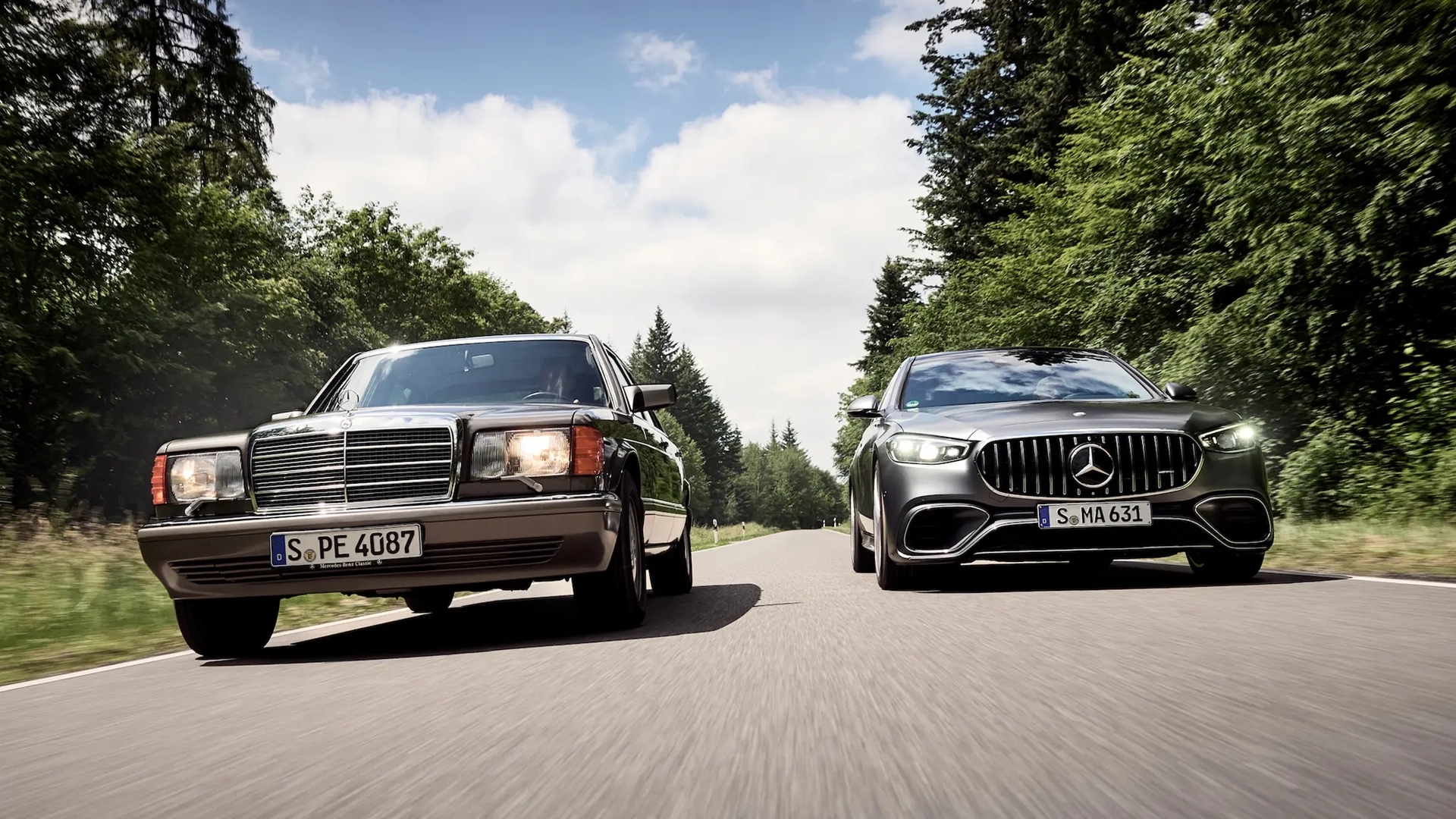
A falling star: Mercedes
It's hard to find another company in the automotive industry with prestige and brand value as high as Mercedes. Founded in 1926, Mercedes-Benz has a history full of outstanding achievements and revolutionary innovations, which they proudly display at their 9-story museum in Stuttgart. For many years—especially in the S-Class—they were the first to implement various technologies and features that later became industry standards after being adopted by other brands and offered in more accessible models.
However, since around 2015, the brand has been undergoing a radical transformation. The increasing digitalization of cars, the accelerated transition to electric vehicles, and rising costs have cornered Mercedes—a company known for building traditional high-quality cars for an aging customer base—and forced it to make some risky decisions. Once synonymous with “overengineering” and durability, the brand has recently become associated with trim noises, workmanship defects, Renault engines, and both mechanical and electronic failures.
In Turkey as well, complaints about the brand—whose models are on average about 10% more expensive than those of its competitors—are on the rise. We can evaluate the severe drop in Mercedes’ production quality and the accompanying issues under four main categories:
1. Build Quality
The biggest gap between the Mercedes models we’re used to and respect, and the current models, reveals itself in the cabin. For the past few years, it’s become a trend on social media to share videos of Mercedes cars creaking from all over. What’s truly striking is that poorly fitted, flimsy plastic components with piano black, aluminum, or wood-look finishes are now widely used—even in upper-segment models.
A recent example showing how far the brand has fallen is the center screen of the W206 C-Class, which detaches from its frame after being left under the sun for a while. The standard sound system of the same model, which doesn’t even include tweeters, is the weakest among its peers.
2. Engine Failures
We previously mentioned that the pre-facelift C200d version of the previous-generation W205 used a 136-horsepower 1.6-liter diesel engine with the OM626 code—based on Renault’s R9M unit—which tends to suffer piston and block failures between 100,000 and 150,000 kilometers.
Although Renault is often blamed for this issue, Mercedes' own downsized, mild-hybrid-assisted gasoline engines have also shown increasing problems in recent years. Particularly, the 1.5-liter M254 engine producing 204 hp, commonly found in current C200 models, has been known to fail at extremely low mileages like 10,000–20,000 km due to manufacturing defects—often requiring a full engine replacement.
There are many listings of such C200s for sale, with new engines installed, priced around 360,000 TL. The reason for the damage record (Tramer entry) is that, in cases where vehicle owners don’t voice their complaints loudly enough—like in the previous example—Mercedes classifies the malfunction as user error and excludes it from warranty coverage.
Similar complaints have been made in the comment section of my 2022 Mercedes C200 short video.
3. Software Issues
Problems like screen freezing/shutting down, inability to use CarPlay effectively, and constant error messages are very common in modern Mercedes models. However, customers’ biggest complaint is about ‘Me Connect’. This app activates key features such as internet connectivity, software updates, dynamic route calculation, and remote access.
In 2019, Turkey’s Information and Communication Technologies Authority (BTK) imposed restrictions on in-car internet use due to security concerns. In 2023, internet access was reauthorized for car manufacturers that met the necessary conditions.
However, Mercedes-Benz Turkey delayed the process, citing infrastructure work, and promised customers that Me Connect would soon be activated when selling models like the E180, EQE, S-Class, and EQS between 2022 and 2024.
Although the brand announced in August 2024 that the app had been reactivated, none of the customers who bought the vehicles mentioned above had been able to use it by then—and they are still waiting. You can read more details about the situation here and in the comments below.
Another recent development concerns the EQA and EQB 250+ models, and this time it's not limited to Turkey. Due to a fire risk, 33,705 vehicles produced between 2021 and 2024 are being recalled for a BMS (Battery Management System) update. However:
- Charging speed will be reduced, with the 10–80% charge time increasing from 34 minutes to 44–49 minutes.
- Battery capacity will be reduced by 5–11%, cutting range by around 50 km.
- As a result, models equipped with the new 70.5 kWh battery will perform worse than the previous 66.5 kWh versions.
4. Service Attention
Despite all these problems and the decline in quality, if the after-sales service were truly “premium,” the extra money paid for the brand image might be justifiable. Unfortunately, Mercedes-Benz authorized services in Turkey frequently fail to meet expectations for customer satisfaction.
One of the latest examples of this is a customer who repeatedly took his Vito to Has Otomotiv over a six-month period due to a simple ventilation issue. After countless visits without a solution and facing indifference from service employees, the customer finally lost patience and destroyed the vehicle himself.
9 Comments