

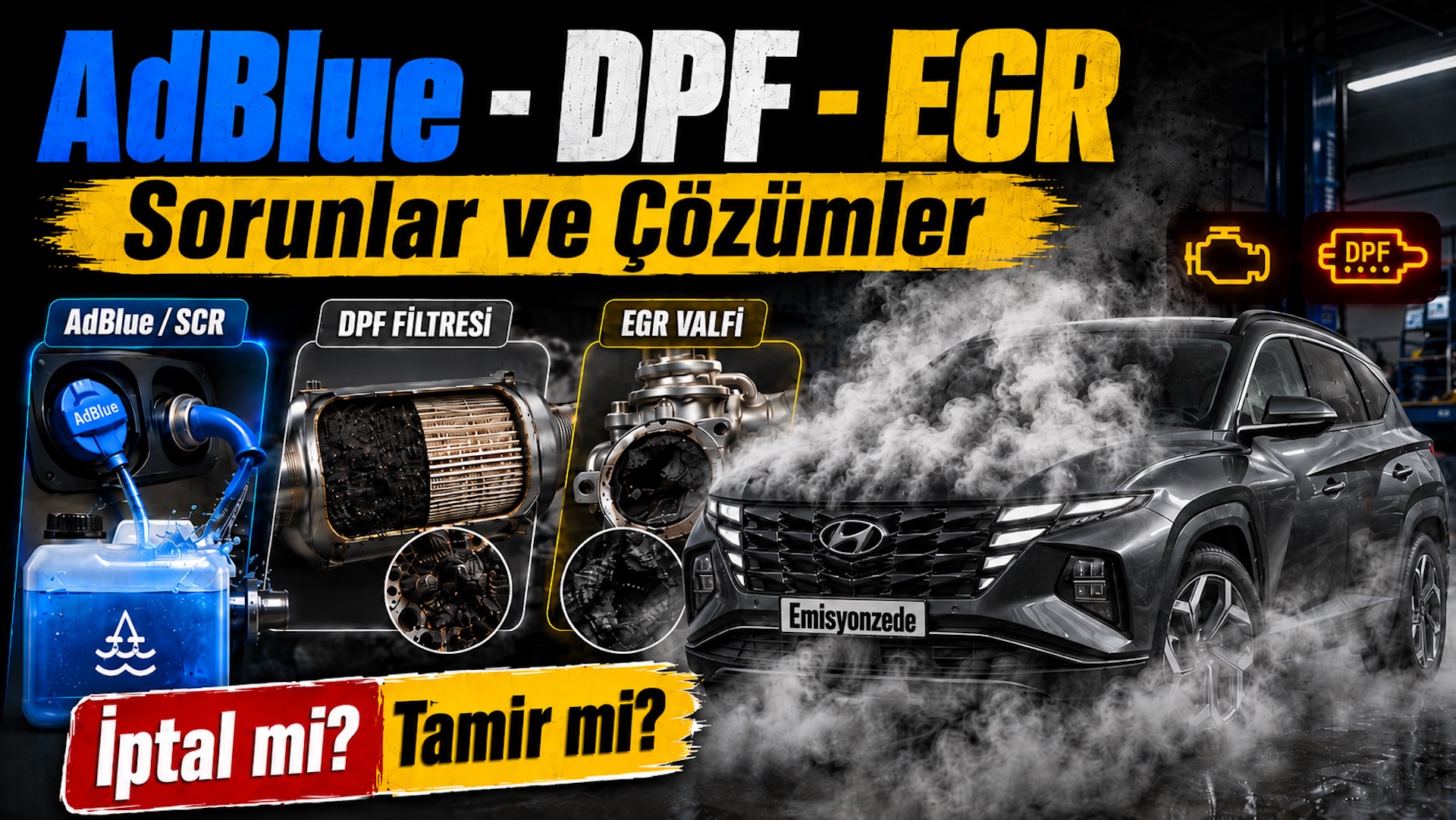
AdBlue-DPF-EGR Problems, Solutions and Costs
Diesel engines, once a favorite among many car owners thanks to their low fuel consumption and high torque output, have become far more complex and costly today as a result of increasingly stringent emissions standards. Every additional system fitted to reduce their environmental impact has brought with it new failure risks and extra costs. The main ones are EGR, DPF, and SCR systems using AdBlue.
1. What are they?
- EGR: “Exhaust Gas Recirculation”; it redirects part of the exhaust gas back into the engine. The system consists of components such as the EGR valve, EGR cooler, bypass flap and position sensor. It is used in both diesel and gasoline engines.
- DPF: “Diesel Particulate Filter”; it physically traps particulate matter in the exhaust. Regeneration is the process of raising exhaust-gas temperature once the soot load reaches a certain level, burning off the soot and converting it mainly into carbon dioxide.
- AdBlue: The fluid — a urea solution — used in SCR, or “Selective Catalytic Reduction,” systems. AdBlue is injected into the exhaust stream, where the urea ultimately produces ammonia; this reacts in the SCR catalyst to convert most NOx, or nitrogen oxides, into nitrogen and water.
2. How long have they been in use?
- EGR: Became widespread with the Euro 4 standard in 2005; adoption in Turkey followed at around 2007.
- DPF: Became widespread with the Euro 5 standard in 2009; adoption in Turkey followed at around 2011.
- AdBlue: Became widespread with the Euro 6 standard in 2014; adoption in Turkey followed at around 2016.
3. What goes wrong?
- EGR: Exhaust soot combines with oil vapor and forms deposits inside the valve and passages. The valve can stick, while the actuator and position sensor can fail, and the EGR cooler can develop leaks.
- DPF: Short-distance and low-rpm driving can prevent the conditions required for regeneration from being reached or cause active regenerations to be interrupted. Other issues include soot and ash accumulation, cracking or melting of the filter core, and faults in pressure and temperature sensors or their hoses.
- AdBlue: Poor-quality or contaminated fluid can damage the pump and injector. Low exhaust-gas temperatures or incorrect dosing can cause urea-based deposits to form around the injector tip, mixer and exhaust system. Pump, tank-module, heater and NOx-sensor failures are also common.
4. How are they fixed?
At this point, it is important to distinguish between the proper, legal solutions and the cheaper solutions commonly used in practice.
Proper solutions
- EGR: If the EGR valve is mechanically sound and its movement is restricted only by deposits, it can be removed and cleaned. If the electric actuator, position sensor or gears have failed, the valve is replaced.
- DPF: If the filter is physically intact and the soot load remains within safe limits, a service regeneration can be carried out. A filter that is ash-loaded but still has an intact ceramic structure can be removed and professionally cleaned using specialist equipment. If the ceramic core is cracked, melted, or heavily contaminated by oil or coolant, the filter is replaced.
- AdBlue: If crystallization is superficial and the injector itself is still functional, the system can be cleaned. If the pump, heater, sensor or wiring is faulty, the relevant component is repaired or replaced. On systems where these components are sold only as part of a complete module, the entire AdBlue tank assembly may need to be replaced.
Improper solutions
- EGR: The ECU’s EGR commands and flow monitoring are disabled (software delete). A blanking plate can also be fitted to the EGR passage or the valve can be fixed in the closed position (mechanical delete). In many cases, both methods are used together.
- DPF: The filter housing is cut open, the ceramic core is removed or drilled out, and the housing is welded back together. Alternatively, the filter can be replaced with a straight pipe (hardware delete). The DPF soot-load calculation, differential-pressure monitoring, regeneration commands and related fault codes are then disabled (software delete). Usually, both hardware and software modifications are carried out together.
- AdBlue: The most common approach is a software delete. The engine or SCR control software is modified to stop AdBlue dosing, suppress NOx and SCR-efficiency monitoring, disable fault codes and deactivate the no-start countdown.
5. What are the risks of deleting them?
Vehicle inspection
- Diesel exhaust-emissions testing in Turkey is based on opacity, or smoke density; NOx, particle number and the actual operation of emissions-control systems are not measured directly. As a result, some vehicles with deleted DPF and EGR systems can still pass the emissions test if the engine is in good condition and the measured opacity remains within the legal limit.
- An illuminated check-engine light is not, by itself, classified as a “major defect.” However, the vehicle will fail inspection if it fails the emissions test or if the exhaust system is found to be non-compliant with regulations.
- If obvious physical modifications such as a straight pipe, a removed DPF, or visible cutting and welding are detected, the vehicle may be classified as having a “major defect” on the grounds that the exhaust system does not comply with the relevant regulations.
Administrative fines
- TRY 17,957 for a vehicle owner who has not had the required exhaust-emissions test performed.
- TRY 17,957 for operating a vehicle without its exhaust-emissions control system.
- TRY 35,936 for operating a vehicle whose emissions exceed the regulatory limits.
Warranty and technical risks
- If the original ECU software is reinstalled during servicing or as part of a recall, a previously applied emissions-delete calibration may be overwritten. If the DPF/EGR/SCR system has been deleted, the vehicle may then generate fault codes and enter limp mode.
- Disabling the EGR system can increase combustion-chamber temperatures. If the engine calibration has not been adjusted accordingly, knock or harsh combustion, higher exhaust-gas temperatures and additional thermal stress may occur.
- If unauthorized ECU software or emissions-system modifications are detected, the manufacturer may exclude related engine, turbocharger, injection-system and exhaust-system failures from warranty coverage.
6. How much does it cost?
- Professional DPF cleaning generally costs a few thousand Turkish lira.
- EGR cleaning or minor repairs also usually remain within the few-thousand-lira range.
- DPF, EGR or AdBlue deletes generally cost around TRY 3,000–10,000.
- Replacing a DPF, SCR catalyst or AdBlue tank with an original part can start at around TRY 50,000 and exceed TRY 200,000.
4 Comments